Published: Socion. No. 2, 1997
Yu. V. Roslankina, V. V. Piatnitsky
Some Considerations on the Phenomenon of One-Dimensionality
Abstract. This article examines the concept of dimensionality in socionics functions, with particular attention to one-dimensional functions and the role of individual experience. The authors discuss the relationship between dimensionality, norms, situations, time, personality development, and the broader dynamics of quadra succession, presenting the argument as a set of exploratory hypotheses for further discussion.
Keywords: socionics, dimensionality, one-dimensional functions, TIM model, experience, norms, quadra succession, personality development.
Introduction
Two remarkable principles embedded in humans—universality and specialization—find their reflection in the socionics TIM model. The model of each IM type contains mechanisms for processing information on each of the eight aspects of the information flow distinguished by socionics. Each aspect of information about the surrounding world, for any TIM, falls into its own processing device, its own processor, which is known as a function of the socionics model. Each function has its own unique functional purpose in the model and its own dimensionality. This determines the uniqueness of the functional orientation of each of the 16 TIMs.
Dimensionality. In our view, this concept, which, along with the TIM model, is a stroke of genius, serves as the key to understanding the mysteries of the informational functioning of the psyche [A. V. Bukalov]. The authors would like to dedicate this article to certain worldview aspects of understanding the dimensionality of socionics functions.
Dimensionality of Socionics Functions
So, dimensionality. All eight functions have an "experience" vector in their structure, six out of eight have a "norms" vector, four have a "situations" vector, and only two out of eight contain a "time" vector. Drawing an analogy with geometry, it can be said that dimensionality is a parameter present when an information aspect is mapped onto the human psyche. However, if a function contains more dimensions, this by no means implies that it contains "more" information. In fact, a high-dimensional function is high-dimensional not because it contains more information, but because the number of parameters taken into account during its processing increases. The difference in the operation of a higher-dimensional function lies in the breadth of the approach and better linking of information, which allows for a more optimal result that is more appropriate to the situation. Resolving a task within the aspect of a one-dimensional function is based exclusively on personal (individual) experience and does not depend on the experience of society (social norms), the current environment, or the specific features introduced into the situation by a moment in time. Consequently, it cannot be optimal, unlike a decision within the aspect of a four-dimensional function.
Nothing prevents a one-dimensional function from containing a lot of information, i.e., knowledge and data gained in situations that the individual had to encounter. On the other hand, a one-dimensional function, no matter how much information it contains, will never become two-dimensional. It will never be able to interpret information along its aspect by relying on accepted norms, situations, or time parameters.
This is closely related to the misconception regarding "weak" and "strong" functions. For instance, if a person speaks or acts according to a specific aspect all the time, this aspect is immediately declared to belong to a "strong" function. However, a person with a well-filled Super-ego will be able to demonstrate "strong" performance even of the fourth function. Yet, what they cannot do is take social norms into account while doing so.
That is, the characteristic feature of a function is its dimensionality rather than its "strength" (or, in other words, its information content). It can be said that the dimensionality of each function determines its functional purpose in the model of the psyche. Thus, for example, the creative function (the second) contains the dimension of the situation at a fixed coordinate of time, which allows it to produce situationally optimal "creative" decisions.
Experience as a Foundational Dimension
Now let us try to trace the functional purpose of the experience functions. Experience is a most interesting parameter in the structure of the TIM model. Dictionaries define the category of experience as practice-based sensory-empirical knowledge of objective reality—the aggregate of knowledge, skills, and abilities derived from life and practical activity. One of the nuances of the concept of "experience" is phrased as: "that which has already taken place, which has already been tested in practice, in life, which one had to encounter", which, in our opinion, most closely describes the socionics meaning of this concept. A philosophical dictionary provides an understanding of experience as the foundation of knowledge and the criterion of truth.
In light of the latter statement, it is clear why the dimensionality of experience is present in each of the eight socionics functions. After all, insofar as a person can rely on their experience, they can be autonomous in their actions and deeds. A person who lacked the dimensionality of experience would not be able to perform any action—there would simply be nothing for them to rely on. Carrying this thought further, it can be assumed that the manifestation of other dimensions is simply impossible without experience. Experience is the elementary information component that makes it possible to link the internal activity of the human psyche with the external world.
Interestingly, the suggestive function, which possesses increased suggestibility, contains exclusively individual experience. That is, suggestibility is selectively determined only by deeply individual experience. And vice versa: what is suggested is accumulated as experience. What kind of experience is this?
One-Dimensionality, Individual Experience, and Development
A hypothesis was put forward that the dimensionality of experience in the structure of a function serves as a repository for incarnational experience [V. D. Yermak]. This is entirely possible, especially since little is known about it, and there are difficulties in investigating this hypothesis. However, observations of certain age-related characteristics of personality development suggest that, compared to the dimensions of experience and norms, the dimensions of situation and time could well turn out to be incarnational acquisitions. It has been noted that a child of two to three years old already makes excellent use of their Id block and, if necessary, can make masterly use of the Ego block. Sometimes, they can produce something they simply could not have learned in their short life. Thus, let us assume that a person receives incarnational information in the form of the dimensions of situation and time, while the dimension of experience serves to accumulate experience as a means of connecting higher dimensions with the immediate sensory realities of the external world.
In language, there is an expression "not of this world," denoting a person who is too deeply involved in creativity (which mainly utilizes the Ego block) and does not align their behavior with what is accepted (i.e., with social norms). On the other hand, a person subjectively perceives their low-dimensional functions as life difficulties that they have to cope with (compare this to the religious redemption of sins in earthly life).
The TIM model contains four functions filled exclusively with imprints of the experience of a person's interaction with the world (their individual experience) or imprints of interaction with society (social experience). On one hand, it might seem that since low-dimensional functions are located in the control blocks, a person's destiny is somehow controlled by experience and norms. That is, destiny seems to be determined here. But what is the meaning of this control then?
One can observe many people who strive throughout their lives to accumulate material precisely regarding low-dimensional functions. This includes, first and foremost, a poorly controlled desire to get as much information as possible regarding the suggestive function. As for the fourth function, here too, through difficult and persistent work on oneself, a person strives to overcome their shortcomings—that which, as they say, is "not given" (a very telling idiom). Indeed, the very name of the Super-ego block means "super-I," that is, what a person does not possess but would like to possess. The same is true regarding the desire to fill the two-dimensional referential and normative functions, as functions of the experience of society, the social environment. There may also be an opposite tendency, when a person strives with all their might to avoid "complexities," i.e., working on the fourth function. One thing is indisputable: the entire life of a personality seems to revolve around low-dimensional functions, as if determined by them. From the standpoint of common sense, this is generally not surprising: after all, it is easy for a person to use high-dimensional functions, so they do not pay special attention to them.
If we consider human evolution as the evolution of consciousness, it can be assumed that the vital ring corresponds to the path already traveled by consciousness. The vital Id block corresponds to that side of consciousness that has already been thoroughly worked out in the course of evolution. Super-id represents the omissions and flaws of consciousness. Mental represents what can be called the "zone of proximal development" for consciousness. At the same time, the Super-ego block is designed to eliminate the gaps of past developmental stages on a conscious level. A clarification must be made here. Usually, socionists imply the information contained within blocks and functions. However, when we speak of developmental gaps, we assume a structural side rather than an informational one. From our point of view, it is the structure of psychic functioning that develops in the course of evolution, rather than the level of content. The actual informational filling of the functions is a reflection of the aspectual structure of the world in which the psyche is immersed. In this case, the real material world serves as a kind of tool, a "grinding stone," by means of which the psyche is perfected in the course of evolution. And it is primarily the low-dimensional functions that are subject to this grinding.
Perhaps this is precisely what explains why people frequently choose a career whose aspectual structure does not correspond to the functional orientation of their TIM. And this does not always happen because they are unaware of their "weak" sides—very often, they do this consciously. Even those who have successfully found a job corresponding to the orientation of their TIM often choose a hobby in such a way as to train the Super-ego. Many (if not all) spiritual teachings speak of the need to openly face the limitations of one's human nature in order to move beyond them, gaining freedom both from limitations (read: Super-ego) and from passions and uncontrolled desires (i.e., Super-id).
In nature, nothing happens "just because" or "just in case." And the significance of low-dimensional functions in the model goes beyond the scope of "weak spots." Practice shows that they are not only the repository of the main (informational) defense mechanisms, but also largely determine the direction and prospects of personality improvement in the process of informational interaction with the world. The accumulation of experience naturally occurs across all functions of the model, since the information flow falls upon the entire model at once, and a person acts across all aspects at once. However, one-dimensional functions possess only the dimension of experience, while two-dimensional functions possess the dimensions of experience and norms (where a norm is the generalized experience of significant others). This is precisely what determines their uniqueness and significance in the TIM model.
Dimensionality of Quadras and Social Evolution
From the standpoint of the put-forward assumptions, it is interesting to look at a concept such as the dimensionality of quadras in the socion [A. V. Bukalov]. It is no coincidence that in the process of civilization's development, each quadra performs its own function and has its own special significance. This can be compared not only to a production process, as has already become customary when explaining the law of quadra succession, but to the evolution of the social structure—the integral psyche of society—if the latter is considered a holistic organism.
Dimensionalities in the law of quadra succession can be interpreted as follows. The first quadra (with which development hypothetically begins) possesses four dimensions. As quadras change, the dimensions decrease, and in the fourth quadra, only the dimension of experience remains. As mentioned above, this does not imply that the amount of information in the fourth quadra is smaller. It is simply that this information carries the character of being firmly established and tested through long-term experience, whereas in the first quadra, it carries the character of new ideas. This is followed by a leap to the first quadra, and the process repeats. At a new turn of development, the information of experience contained in the previous fourth quadra transitions into the dimension of experience of the new first quadra. Here, an analogy can be drawn with human life: while a person is young, the content of their life consists of possibilities, potentials, and options. As they mature, life acquires a defined, established character, and by old age, a person becomes the embodiment of life experience.
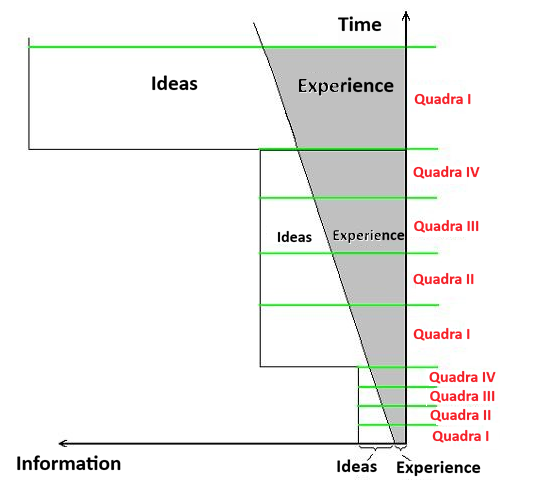
Fig. 1
We have attempted to illustrate the process of quadra succession in Fig. 1. One detail catches the eye here: the increase in experience proceeds continuously from period to period, whereas the increase in the volume of ideas moves in leaps. Where, then, do new ideas come from? It can be assumed that they come from somewhere outside. Let us note that the initial premise was the movement of development from the first quadra to the fourth, i.e., from idea to experience. If we assume a reverse path of development, that is, from experience to idea, the picture will change to the opposite.
What has been said is closely related to the fundamental question of philosophy: which is primary—the idea or matter. If the law of quadra succession is valid, it turns out that the idea is primary. This is so because the change in experience is continuous, while the dimensionality of the idea changes by a leap—that is, a kind of injection of the ideal is observed. Although the conducted reasoning suffers from being speculative and imprecise, it nevertheless prompts serious reflection.
Conclusion
In conclusion, the authors would like to emphasize that the presented ideas are assumptions and do not claim scientific validity. We wanted to put forward some hypotheses that are interesting from our point of view and invite readers to discuss such an important topic in socionics as dimensionalities.
References
- Slovar russkogo yazyka: v 4-kh t. [Dictionary of the Russian Language: in 4 vols.] / AN SSSR, Moscow, Russkiy yazyk, 1985–1988.